
Articles
Session notes — SurveyDesk live build (12 Sep 2026)
Durable notes from the English Saturday session: Spec-Driven Development, SurveyDesk across web/iOS/Android, Agent on Rails, Gherkin + ADR as guardrails, and local-agent cost. Complementary to the YouTube recording — not a transcript replacement.
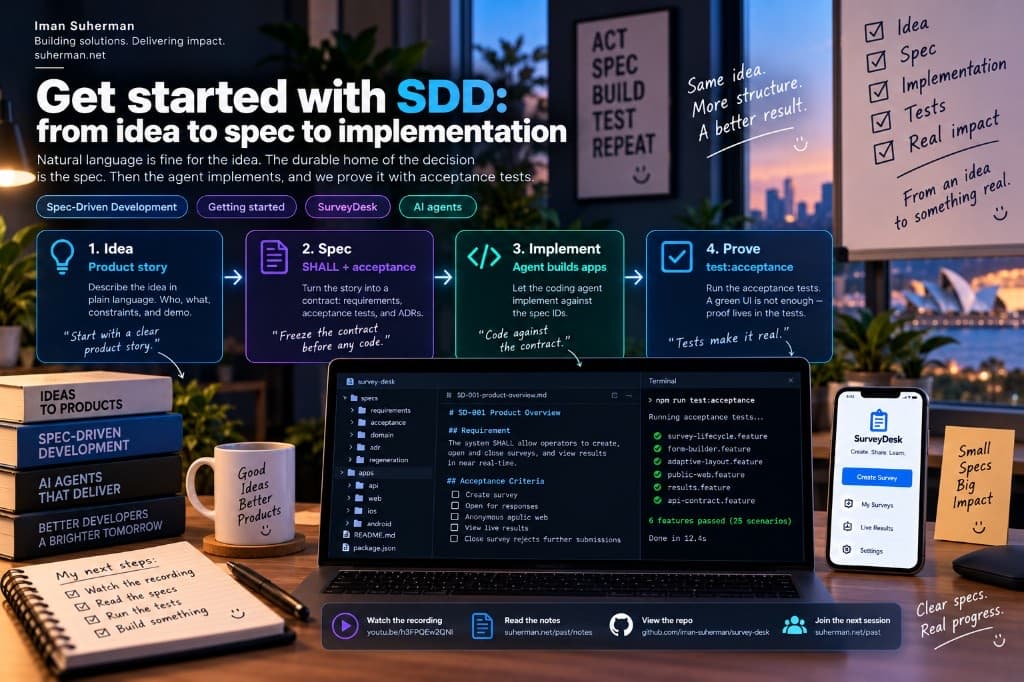
Saturday, 12 September 2026 — Build an App with AI, Live (English). We built a public survey engine end-to-end from GitHub specs in Cursor for roughly two to three US dollars, then ran it on web, iPhone, iPad, and Android with instant shared results.
- Recording: https://youtu.be/h3FPQEw2QNI
- Repo: https://github.com/iman-suherman/survey-desk
- Beyond Gherkin (ADR / SHALL / OpenAPI): https://suherman.net/articles/beyond-gherkin-adr-shall-openapi
Takeaways
- AI survey engine under $3 — end-to-end from specs in Cursor.
- Cross-device demo — web, iOS (Swift), Android worked together with instant results.
- Specs drive the agents — update specifications; do not hand-edit colliding agent code.
Spec-Driven Development
- AI is an engine under human control — context must be managed carefully.
- Gherkin / BDD specs form the project contract; prompts are not the source of truth.
- Architecture Decision Records (ADRs) document choices and guard against hallucination.
SurveyDesk live demo
- Native operators: Swift/SwiftUI on iOS, Kotlin/Compose on Android, plus anonymous public web.
- Local-first SQLite avoids heavy cloud setup during the demo.
- Forms via JSON FormSpec; lifecycle draft → open → closed.
- Validated live on iPhone, iPad, and Android simulators with instant shared results.
Agent on Rails
- Parallel agents run in execution waves for backend, web, iOS, and Android without stepping on each other.
- Specs are the control plane; Gherkin acceptance checks verify the workflow.
- Named after Ruby on Rails — keep autonomous multi-agent work on track.
- Incremental changes: update the spec (e.g. iPad refresh), then let agents regenerate — don’t fight the code.
Local agents & cost
- Prefer local coding agents when possible to avoid high LLM bills.
- With solid specs as the control plane, which agent you use matters less than the contract.
Why a survey desk
Pre-session poll top themes were form + workflow automation, internal tooling, and mobile. Those combined into one local survey desk meant to replace paid tools like SurveyMonkey for the demo narrative.
Live walkthrough
Backend via npm run demo, iPhone/iPad simulators and Android emulators, create a feedback survey (choice, text, stars), publish, open the public URL, submit, and watch results refresh across devices. Acceptance tests: npm run test acceptance.
Q&A themes
Incremental revisions via spec updates; flexible markdown/spec folder structure as long as humans and agents can read it; cost-efficient local agents (e.g. Ollama/MLX); Agent on Rails naming and conflict prevention.
Where the deeper docs live
If you came here looking for ADR detail: the session only introduced ADRs as guardrails. The full Decision / Why / Consequences files are in the repo and walked through in the Beyond Gherkin article. The YouTube video shows the live energy; it does not replace reading specs/adr/.
- Beyond Gherkin — https://suherman.net/articles/beyond-gherkin-adr-shall-openapi
- Get started path — https://suherman.net/articles/get-started-sdd-idea-to-implementation
- ADRs on GitHub — https://github.com/iman-suherman/survey-desk/tree/main/specs/adr
Adapted from Gemini meeting notes for this live session. Review for accuracy — AI notes can miss nuance.